


 German
 English
 French
 Spanish
 Portuguese
How does a biogas agitator work?
A biogas agitator ensures uniform homogenisation in a biogas plant. It prevents floating layers and sedimentation, distributes heat and nutrients throughout the substrate and creates stable conditions for biological processes. This makes the agitator a key component for safe and economical plant operation.
Below, you will learn how a biogas agitator works from a technical perspective, which types of agitators are used at Paulmichl and what advantages a properly designed mixing system offers.
How a biogas agitator works – explained step by step
The demands placed on a biogas agitator are high: the substrate is often viscous, rich in fibres and varies depending on the feedstocks used, operating conditions, dry matter content and season. The aim of the mixing technology is therefore not to move the contents of the tank as vigorously as possible, but to circulate them evenly and in a controlled manner. The following steps explain how this is achieved technically.
1. Drive and power transmission
An electric motor drives a shaft via a gearbox. At the end of the shaft is the mixing element, which is responsible for moving the substrate. The drive is designed for energy-efficient operation in viscous, fibre-rich media.
2. Generation of a circulation flow
The rotation of the agitator blades sets the substrate in motion. This creates a directed flow that circulates the tank contents throughout the entire vessel. The aim is not aggressive mixing, but uniform, gentle circulation of the entire tank volume.
3. Breaking up floating layers and sediment
Light components such as fibrous materials are mixed back into the liquid phase from the surface. At the same time, heavy particles are prevented from settling permanently at the bottom. This ensures maximum gas yield from the biogas plant.
4. Uniform distribution of heat and nutrients
Agitation ensures that temperature, trace elements and fresh substrate are evenly distributed throughout the digester. This creates stable conditions for microorganisms and ensures uniform fermentation.
5. Stabilisation of gas production
Homogeneous mixing allows the biological processes to operate more consistently. This has a positive effect on process stability, gas yield and plant availability.
Types of biogas agitators at Paulmichl
Depending on the digester size, substrate and application, Paulmichl uses different types of biogas agitators:
Rod agitators
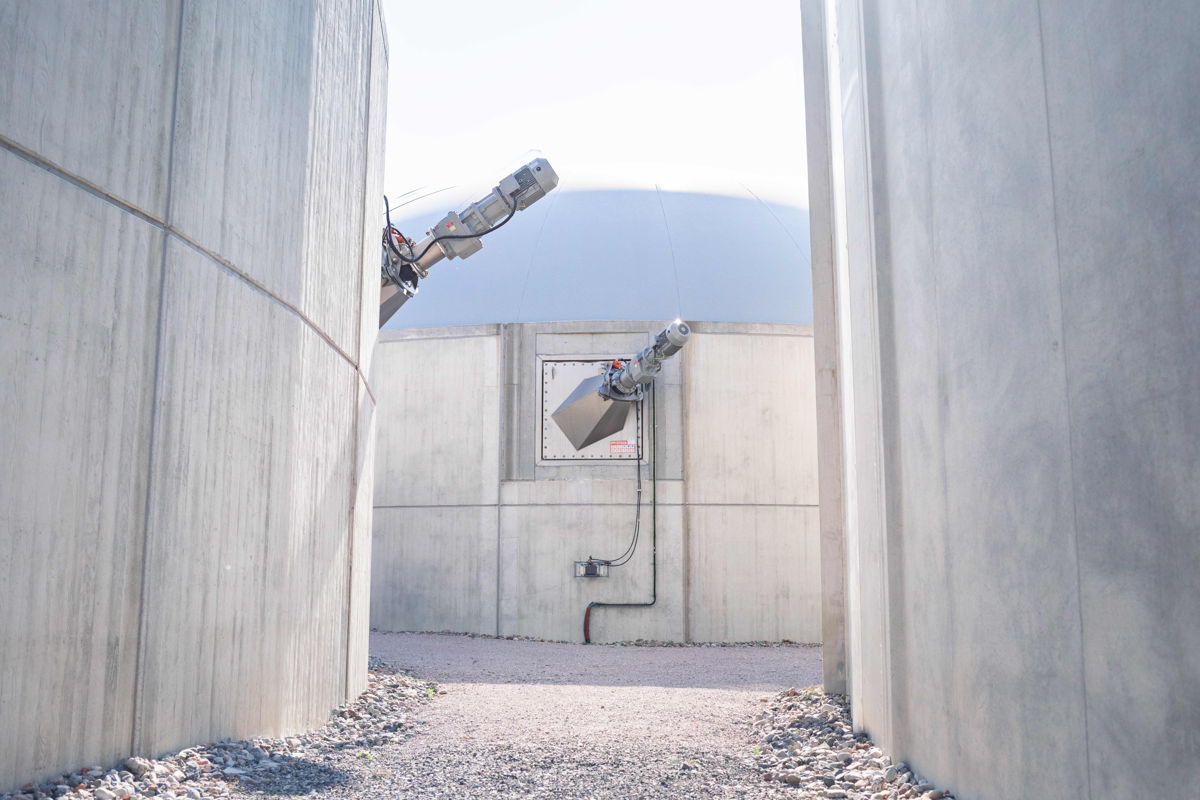
Rod agitators are installed through the wall or roof of digesters and tanks with varying filling levels. They generate a targeted circulation flow and are particularly suitable for breaking up floating crusts and mixing the contents of large tanks.
Submersible motor agitators
In submersible motor agitators, both the motor and the agitator blades are positioned directly in the substrate. This design is compact, robust and particularly suitable for tanks with varying filling levels and final storage tanks.
Discover our submersible motor agitators
Paddle agitators
Paddle agitators operate with large, slow-rotating paddles. They provide particularly gentle mixing and are frequently used for substrates with higher dry matter content or sensitive substrates.
Advantages of properly designed mixing technology
✓ Uniform mixing of the contents of the biogas tank
✓ Prevention of floating layers and sedimentation
✓ Stable biological processes and consistent gas production
✓ Uniform temperature distribution
✓ High plant efficiency with low energy consumption
Insights into efficient agitator technology specifically for biogas plants

 By activating the video function on this website, data is automatically transmitted to YouTube. This data may be stored outside the European Union under lower data protection regulations.
Practical example: Biogas agitators from Paulmichl GmbH
Paulmichl has been developing mixing technology for the biogas and environmental technology sectors for decades. The focus is on robust, durable designs and practical solutions tailored to the specific tank and substrate used.
The potential of customised mixing technology becomes particularly evident when modernising existing plants: if floating crusts, dead zones or uneven temperatures interfere with the process, a properly coordinated agitator system can significantly improve plant stability and economic efficiency.
Which agitator is right for your biogas plant?
Whether you need a rod agitator, a submersible motor agitator or a paddle agitator, we can help you select the right mixing technology or optimise and retrofit existing digesters.
Your contact person:
Martin Wucher
Sales Manager and contact person for biogas agitators at Paulmichl
Phone: +49 7563 / 9124790
Email: info@paulmichl.de